We began with some announcements, chiefly that we will sponsor a Fly Fishing Film Festival March 19. You can order tickets online. Doors open at 530, films at 6 p.m. John Weiss was volunteered to try to get some door prizes from the two fly shops and Scheels.
Feb. 3 meeting will be Jennie Biederman talking about the Lanesboro habitat project, and April 6, Matthew Mitro talking about beaver and trout.
April 11 will be the work day pulling tires and maybe planting trees along Mazeppa Creek and May 11 will be the spring roadside cleanup on US 52.
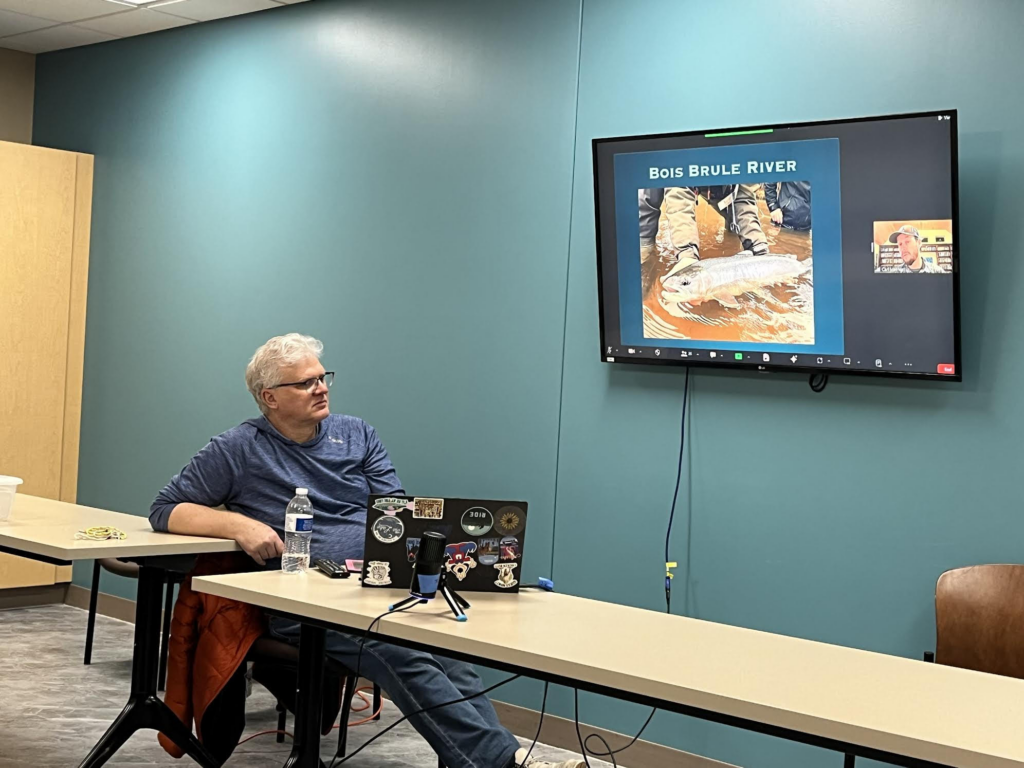
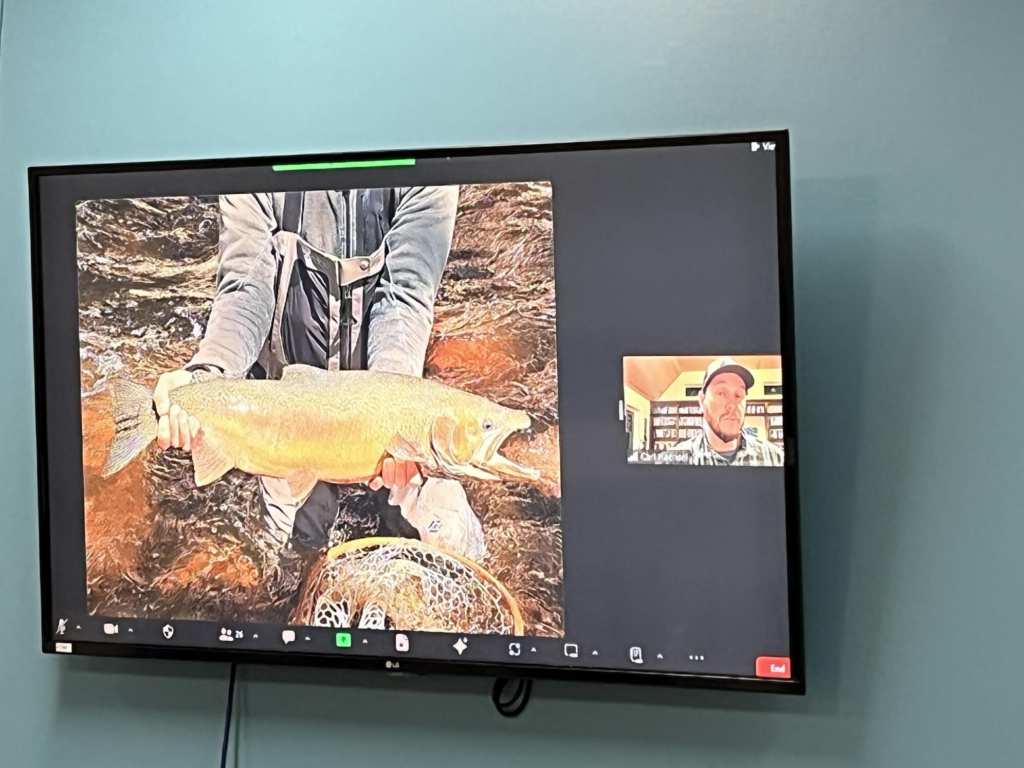
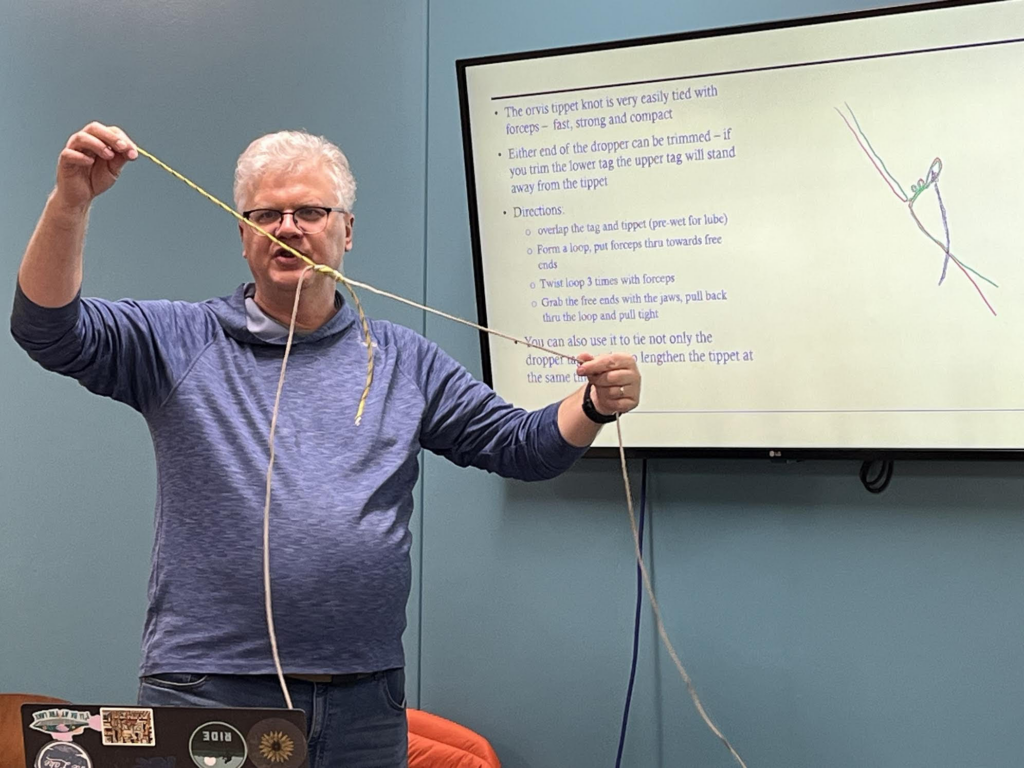
Paul Krolak gave us a short tutorial on how to tie on Euronymphing leaders but THE highlight was Carl Haensel talking about fishing steelhead trout on the North and South shores of Lake Superior. Steelhead are anadromous rainbow trout that go into the rivers to spawn in spring and sometimes also go into the rivers in fall. “Steelhead might seem mythical to some people,” he said, because they are hard to catch, fight fiercely, and are out of reach to most anglers. But if you do it right, “you can make it happen.” And “they are absolutely beautiful.”
NORTH SHORE
Spring is the biggest run, along with some resident pink salmon and coastal brookies. HOWEVER, because most rivers depend heavily on snowmelt or rain, not every year is a great year for fishing. “They are very very water level dependent,” he said.
There are about 20 steelhead rivers between Duluth and Canada, with rivers getting bigger as you go northeast. All will have steelhead IF there’s enough water. Most runs are mid-April to mid-May, with some even beginning April 1. They stay until water gets too warm, then they bail out back into Lake Superior.
There are some stocked steelhead but the vast majority are wild; all wild must be released (look for intact adipose fin). Stocked ones are reared in SEMN; about 120,000 small fish are released annually. Steelhead will stay in the stream generally for two years or they usually don’t make it. Haensel said don’t go small and try to catch a lot of smolt. Fish tend to avoid shorter streams and if they do come in, they often had tried bigger streams.
Fish tend to be chrome but some are darker depending on when they come in. Most can’t get past many falls; they can’t jump past 6 feet. There are also some brook trout, and some suckers.
At the least, you need 12 inches of visibility, better with 18 inches for flies. With less clarity, you can use fish eggs. “Water levels change all the time.”
He tantalized us with many pictures of fish in the mid to upper 20-inch class.
The push comes with the water temperature is 40 degrees and gets going more at 41 degrees.
He begins by going river to river but if it’s cold, fish will stack up near the rivers’ mouthes. You can fish gravel bars but they change year to year. The best place to find fish is in the seams between river and lake water; there is a color difference. Steelhead prefer deeper water on the edge of seams.
Close to Duluth, streams are smaller and warmer but bigger as you go northeast (those have later runs).
TU is helping create more spawning habitat.
SOUTH SHORE
Most of the trout water is between Lake Superior and Bayfield. He focused on the Bois Brule because it’s a superior stream, by far the largest run in the whole region and it has 40 miles of accessible water. It mostly has spring flow so temperatures remain good longer for the fish. Normal flow is 180 cubic feet per second, base flow is about 120 cfs (in Minnesota, streams can go from 180 cfs and drop to 5 cfs in drought).
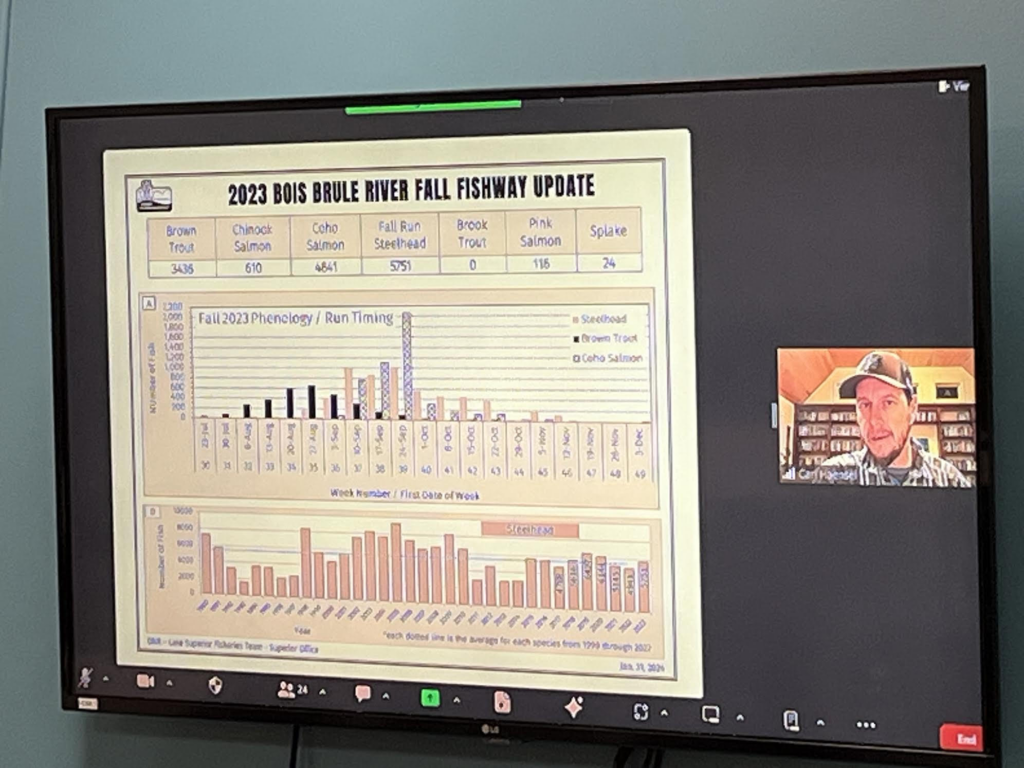
The Brule is 100 percent wild and there is a “very very robust fall fishing run.” They are chrome and “super hard fishing, hard to land.”
They often come in in fall and spend the winter; only about 20 percent of the run is in spring. There are also coho salmon and big brown trout, as well as chinook up to 40 inches.
There are “tons of different water … fish the large water and fish the deeper holes.” You can nymph, tight line or Euronymph. He prefers a 9- to 11.5-foot-long rod, at least 7 or 8 weight and a good reel with backing. The only tippets are 1, 2, or 3.
Don’t forget a BIG net, at least 28 inches and use studs on your boots. “It’s more about presentation” with no fly smaller than a 12, with stoneflies 4 to 10, nymphs 8 to 10 and eggs 6 to 8. His stonefly patterns must be leggy.